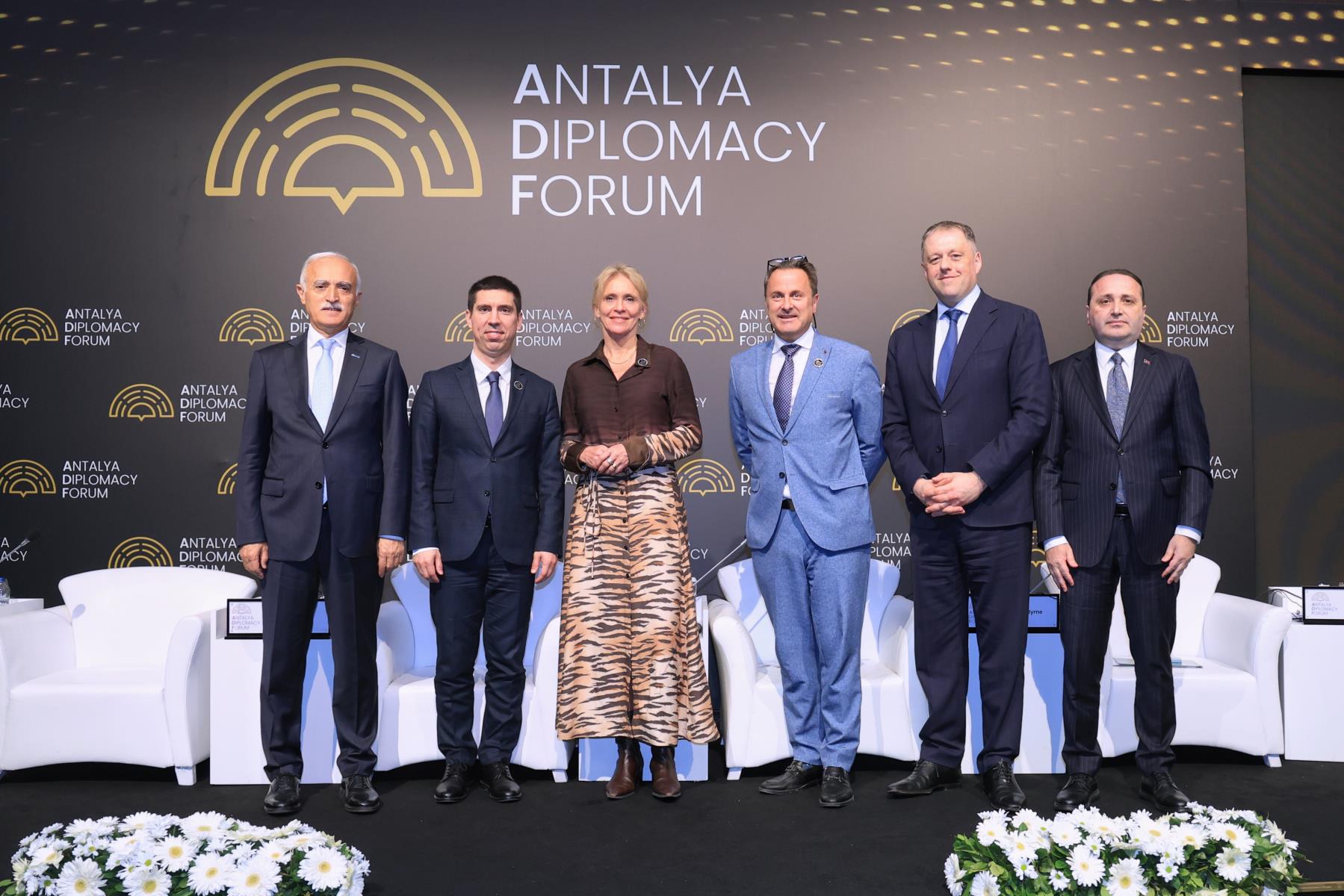
The Panel on "Europe's Competitiveness in the Age of Geopolitical Uncertainties," organized in cooperation with the Antalya Diplomacy Forum (ADF) and DEİK, was held on April 18, 2026, in Antalya under the moderation of DEİK President Nail Olpak. The panel featured the participation of Luxembourg's Deputy Prime Minister, Minister of Foreign and European Affairs, Minister of Foreign Trade, and Minister for Development Cooperation and Humanitarian Affairs Xavier Bettel; Moldova's Deputy Prime Minister and Minister of Foreign Affairs Mihai Popşoi; Iceland's Minister for Foreign Affairs Thorgerdur Katrin Gunnarsdottir; Ireland's Minister of State for European Affairs and Defence Thomas Byrne; and Deputy Minister of Trade of the Republic of Türkiye Mustafa Tuzcu. During the forum, DEİK hosted numerous Heads of State, Ministers, and Ambassadors at its stand.
DEİK President Nail Olpak addressed the issue of competitiveness, which is frequently discussed in the business world, stating:
"We evaluate competitiveness across many dimensions such as price, quality, aesthetics, speed, service, and financing. However, beyond all these elements, predictability has always been and will continue to be our top priority. As the representative of the Turkish business community, and within the framework of Türkiye's EU candidate status, we attach particular importance to addressing these issues from this perspective as well. Will we continue negotiating Türkiye's EU membership for another 60 years and discussing the modernization of the Customs Union for another 30 years? Are we ready to explain to our grandchildren how we limited the future not only by delaying our own opportunities but also theirs? Today's exchange of views once again demonstrates how intertwined our economies are and how important it is to preserve and further strengthen partnerships in an increasingly uncertain global environment. From our perspective, the way forward lies in deepening cooperation based on mutual understanding, shared responsibility, and a long-term vision. At the same time, we must update ourselves according to today's realities. Türkiye and Europe must and will do their best to build a faster, stronger, and genuine partnership during this period of uncertainty, which does not seem likely to end in the short term. I believe that Europe's competitiveness is directly linked to the strength of its partnerships, including Türkiye. In this regard, as the Turkish business community, we are ready to continue working hand in hand with our European counterparts in a constructive and forward-looking manner."
Bettel: "Europe needs a more coordinated industrial policy for competitiveness"
Luxembourg's Deputy Prime Minister and Minister Xavier Bettel stated that Europe needs a more coordinated industrial policy to enhance its competitiveness, emphasizing that Europe should act as a true single market rather than 27 separate ones. He highlighted the impact of energy costs, environmental standards, and social policies on competitiveness, stressing the need for a balanced model without compromising these values. Bettel also pointed out that the rules-based global system is weakening, making economic predictability more difficult in the current environment of uncertainty. Referring to Türkiye-EU relations, he underlined the importance of maintaining close ties and called for mutually beneficial, win-win solutions.
Popşoi: "Significant progress achieved in energy, security, and economy with EU support"
Moldova's Deputy Prime Minister and Foreign Minister Mihai Popşoi described the European Union as one of the most successful economic and peace projects in the world, stating that greater integration is needed to enhance competitiveness. He noted that if barriers to a true single market are removed, Europe has significant growth potential and could potentially double its GDP by eliminating trade barriers. Popşoi highlighted the substantial progress achieved in energy, security, and economic fields with EU support and stated that Moldova has made significant advancements in its EU accession process. He also emphasized that Türkiye is an important trading partner for Moldova and welcomed the strengthening of bilateral trade relations and cooperation.
Gunnarsdottir: "Changing global conditions require stronger integration with Europe"
Iceland's Minister for Foreign Affairs Thorgerdur Katrin Gunnarsdottir emphasized that the European Union is not only an economic structure but also one built on shared values. She stated, "As Iceland, we are not an EU member, but we support membership. The EU is a superpower and should act like one. Competitiveness is not only about the economy; values such as democracy and human rights are also important." She stressed that competitiveness should be evaluated alongside democracy, human rights, and the rule of law, and noted that changing global conditions necessitate stronger integration with Europe.
Byrne: "We want to have great relations with Türkiye and our neighbors"
Ireland's Minister of State for European Affairs and Defence Thomas Byrne recalled that the European Union is fundamentally a peace project and emphasized the need to balance economic growth with social and environmental goals. He stated that efforts are ongoing to strengthen the single market and reduce bureaucracy, adding that green and digital transformations are reshaping the economic structure. Byrne expressed openness to improving relations with Türkiye and said they want to maintain excellent relations with Türkiye and its neighbors.
Tuzcu: "Türkiye is not just a partner but an integral part of the EU's strategic autonomy and industrial transformation goals"
Deputy Minister of Trade of the Republic of Türkiye Mustafa Tuzcu stated: "We are a European country. We expect our friends to accept this. Türkiye has a defense system. It will make a major contribution to industrial competitiveness." He noted that the EU is undergoing a new industrial transformation process to enhance competitiveness, with goals such as closing the innovation gap, achieving carbon neutrality, and reducing strategic dependencies through the "Competitiveness Compass." Tuzcu emphasized that these goals cannot be achieved without strong economic growth. He also pointed out that the EU has shown low growth performance over the past 20 years and its share in global exports has declined, adding that the EU's new approach places greater emphasis on economic resilience and strategic autonomy. Tuzcu warned that current industrial policies risk becoming overly inward-looking, fragmented, and overly regulated. He highlighted that Türkiye is a critical partner for Europe in terms of energy, industry, food, and logistics security, and with its young and dynamic structure, can contribute to solving Europe's growth challenges. He also argued that the Customs Union has become outdated and must be updated to align with current global economic conditions, including areas such as services, digital trade, and public procurement. Tuzcu concluded by emphasizing that Türkiye is not merely a partner but an integral part of the EU's strategic autonomy and industrial transformation objectives.
The sponsors of the event were Eksim, ETİ, Glory Group, Hayat Holding, Roketsan, and Türk Altın.
Related Pictures