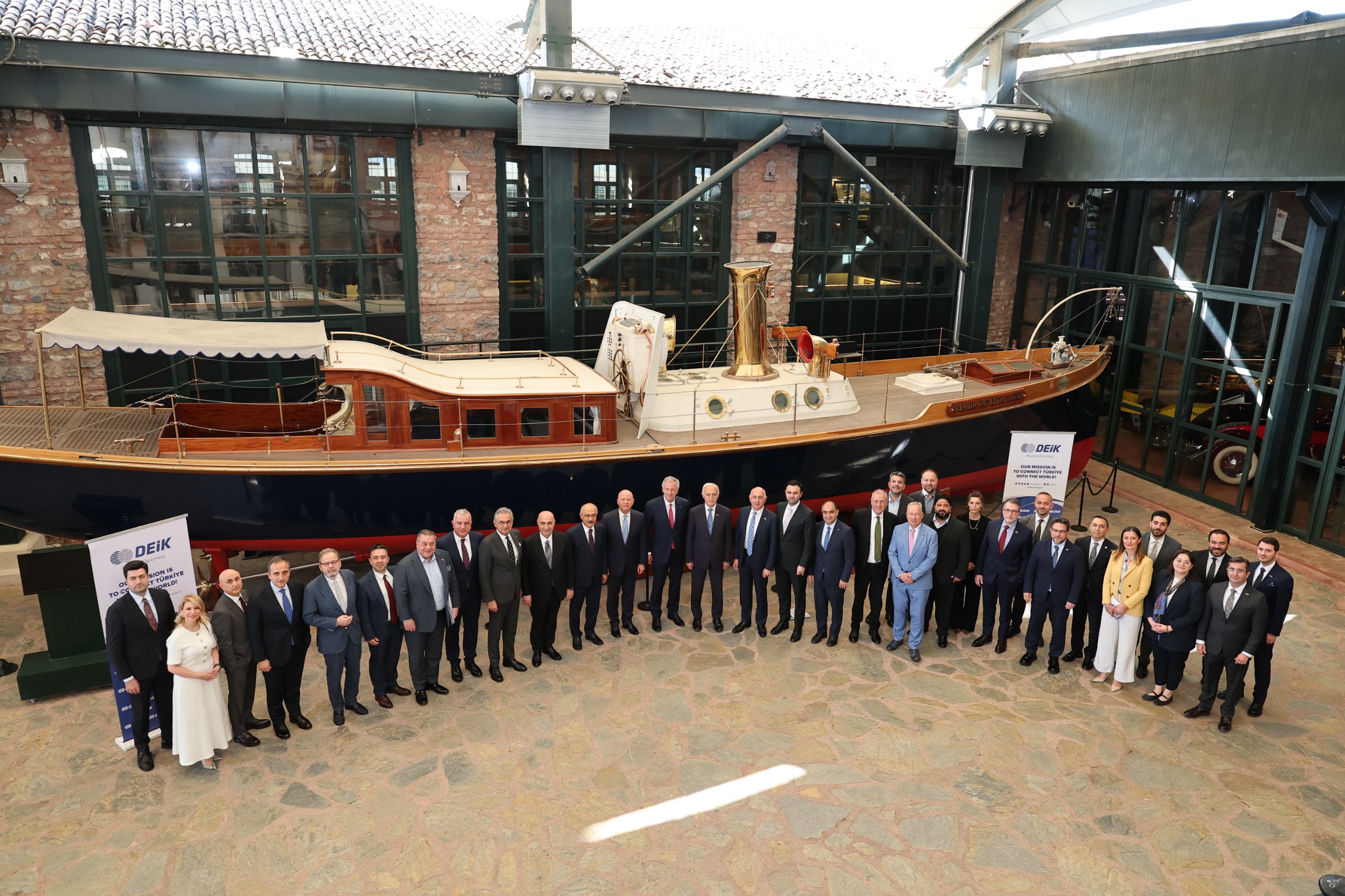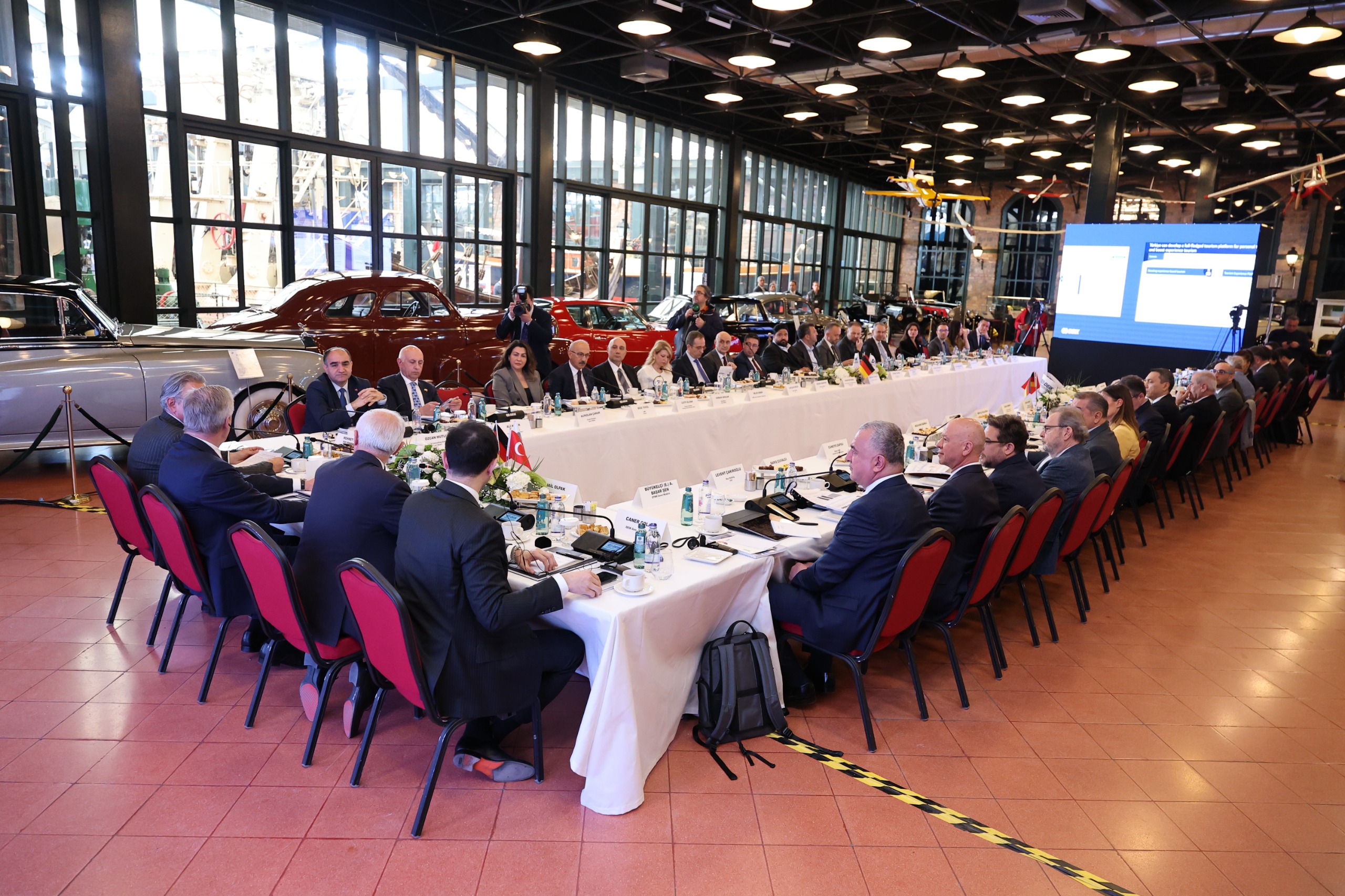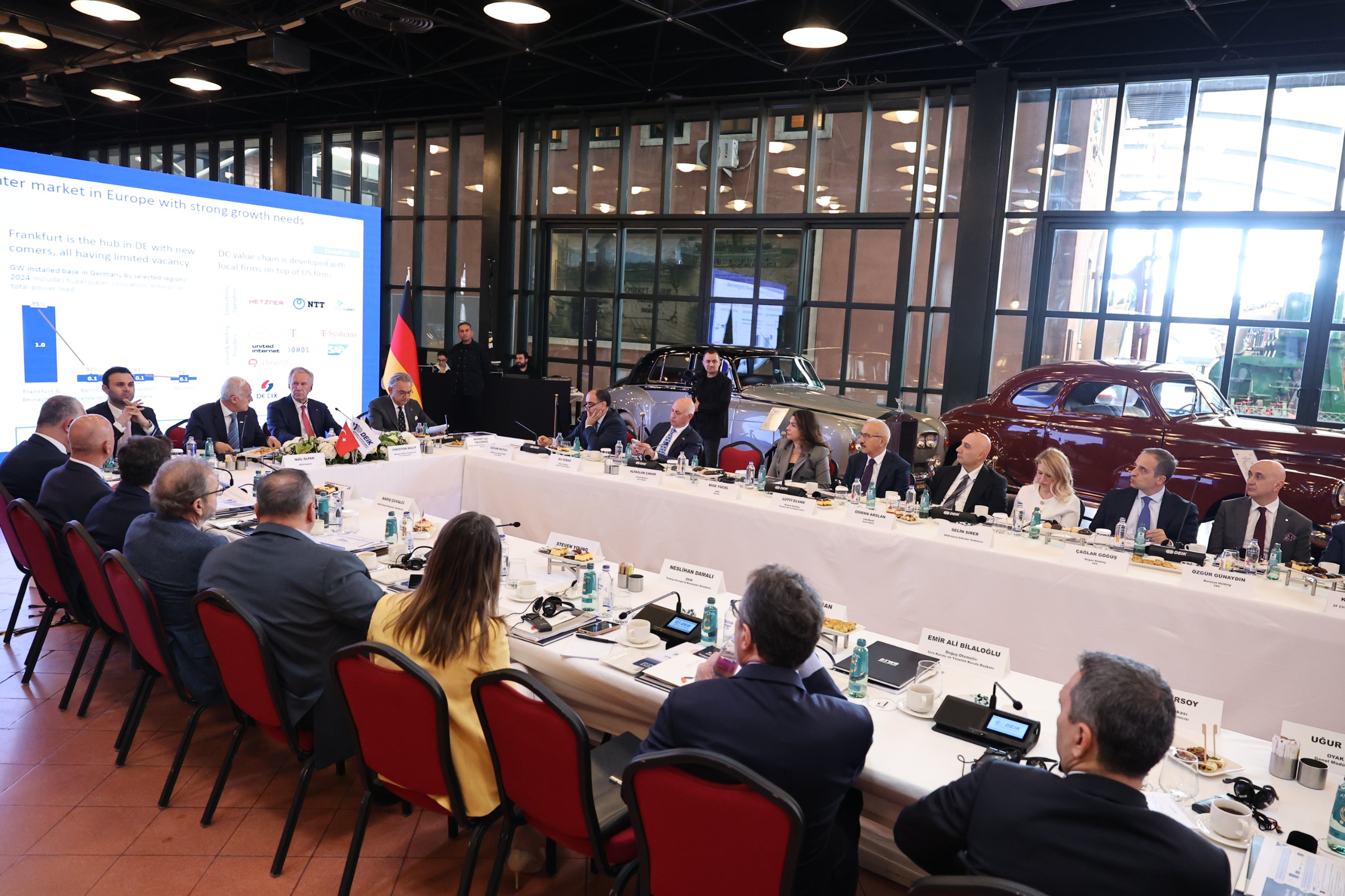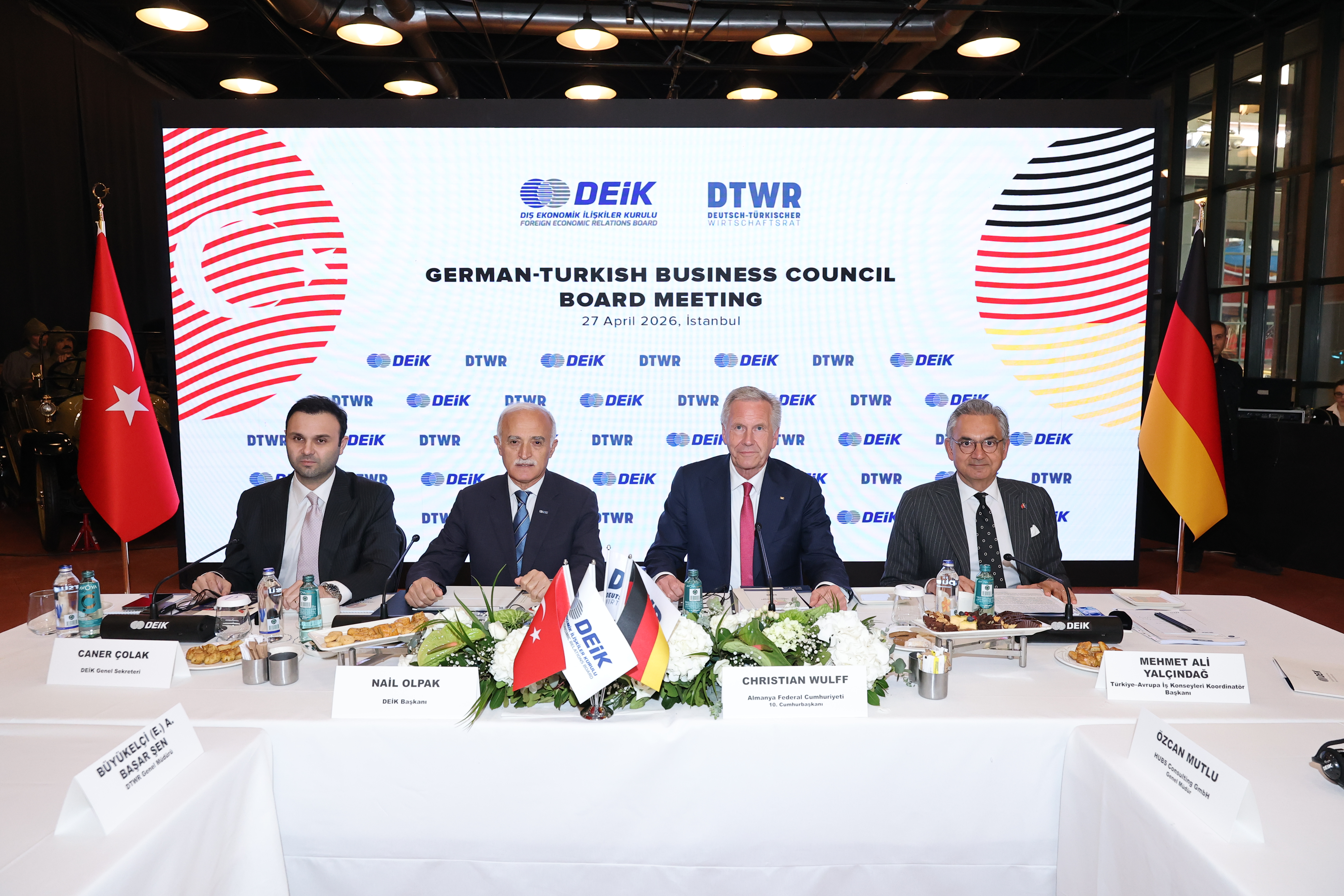
The German-Turkish Business Council Board Meeting was held in Istanbul on April 27, 2026, with the participation of the 10th President of the Federal Republic of Germany and Honorary Chairperson of the German-Turkish Business Council Christian Wulff, President of Foreign Economic Relations Board (DEİK) Nail Olpak, Chairperson of the DEİK/Türkiye-Germany Business Council Mehmet Ali Yalçındağ, and Board Members of the German-Turkish Business Council.
The two main agenda items of the meeting were the "Opportunities in Türkiye-Germany Cooperation for Private Sector Players" report, prepared by DEİK and Boston Consulting Group's Germany and Türkiye offices, outlining a ten-year vision for economic relations between the two countries, and the evaluation of a private sector initiative regarding Türkiye's full EU membership. During the two-hour meeting, Türkiye's strong integration with Germany and the EU in trade and investment, as well as its future vision, were discussed.
DEİK President Nail Olpak stated that Türkiye and Germany are two countries that have built success together over the years by making bold decisions, setting ambitious goals, and pursuing them with determination. Referring to the report, Olpak said that it seeks to answer where the countries could be in the medium and long term.
"Based on projections for 5–10 year periods, we identified potential developments and numerical targets. We analyzed global mega trends and the opportunities and risks they bring. When we examined the future strategies of Germany and Türkiye, we saw that our strategies overlap in many areas. Our bilateral trade volume, currently around €50 billion including services, has the potential to reach €125 billion within 5 years and €250 billion within 10 years," he said.
Olpak: "We identified 10 different growth areas between Türkiye and Germany"
Olpak noted that the report identifies 10 key growth areas based on both countries' future strategies:
Germany and the EU aim to diversify supply chains. Türkiye is strengthening its position as a reliable and increasingly important production hub in close proximity. With deep business ties, supply chain integration, and a similar SME structure, Türkiye is well positioned to invest in Germany with capable partners.
Türkiye offers a cost-effective healthcare system with a digitalized infrastructure. Germany has Europe's third-largest startup ecosystem, strongly supported by the government. Both countries attract high levels of mutual investment in areas such as textiles, productivity, financial software, gaming, climate technologies, and artificial intelligence.
Germany remains a leader in European e-commerce and is working on adapting customs regulations to its challenges. The report identifies areas where Turkish SMEs can be effective in Germany's e-commerce sector and analyzes the platforms and strategies to follow.
Türkiye and Germany can collaborate to address labor shortages in both countries. Data centers in the EU currently account for 2.7% of total electricity consumption, expected to rise to 28% by 2030, highlighting the importance of cooperation in energy.
Türkiye has a strong tourism infrastructure, while Germany is the largest source of tourists visiting Türkiye. The Caspian and African regions hold high economic growth potential, shaped by infrastructure needs, energy transition, and value-added production. Türkiye and Germany can collaborate in these regions by leveraging their complementary strengths.
Wulff: "We must utilize this potential between Türkiye and Germany"
Christian Wulff emphasized that the world needs Türkiye more than Türkiye needs the world, stating:
"We shake hands with the Turks. We shake hands with Türkiye, and Germany's image in Türkiye remains very positive. Therefore, we must make use of this potential between Türkiye and Germany."
He added that Germany is Türkiye's most important trading partner and highlighted Türkiye's geopolitical and strategic advantages, including shifting supply chains toward Mediterranean ports and relatively lower labor costs, which Germany seeks to benefit from.
Yalçındağ: "The time has come for Türkiye's full EU membership"
Mehmet Ali Yalçındağ stated that, considering Germany's strategic weight both for Türkiye and within the EU, leading Turkish companies were invited to be part of this structure. He noted that the report aims to identify ways to expand the current €50 billion trade volume through sectoral priorities and strategic steps.
He explained that the report focuses on key pillars such as geostrategic transformation, climate and energy, innovation and competitiveness, and demographic and labor dynamics.
Yalçındağ: "Our ultimate goal should be Türkiye's full EU membership"
Yalçındağ emphasized that the current level of integration does not fully reflect the potential:
"For a shared and prosperous future, our ultimate goal as the business community should be Türkiye's full membership in the European Union. The EU, with a population of 500 million and an economy of $18.5 trillion, holds significant potential. With Türkiye's inclusion, this would rise to 600 million people and nearly $20 trillion in economic power."
He added that Türkiye's EU membership would enhance regional energy and supply chain security, defense capacity, and digital competitiveness, contributing to greater strategic autonomy.
He concluded that even without full EU membership, Türkiye has already established strong trade and investment ties, and that full integration would create far greater opportunities.
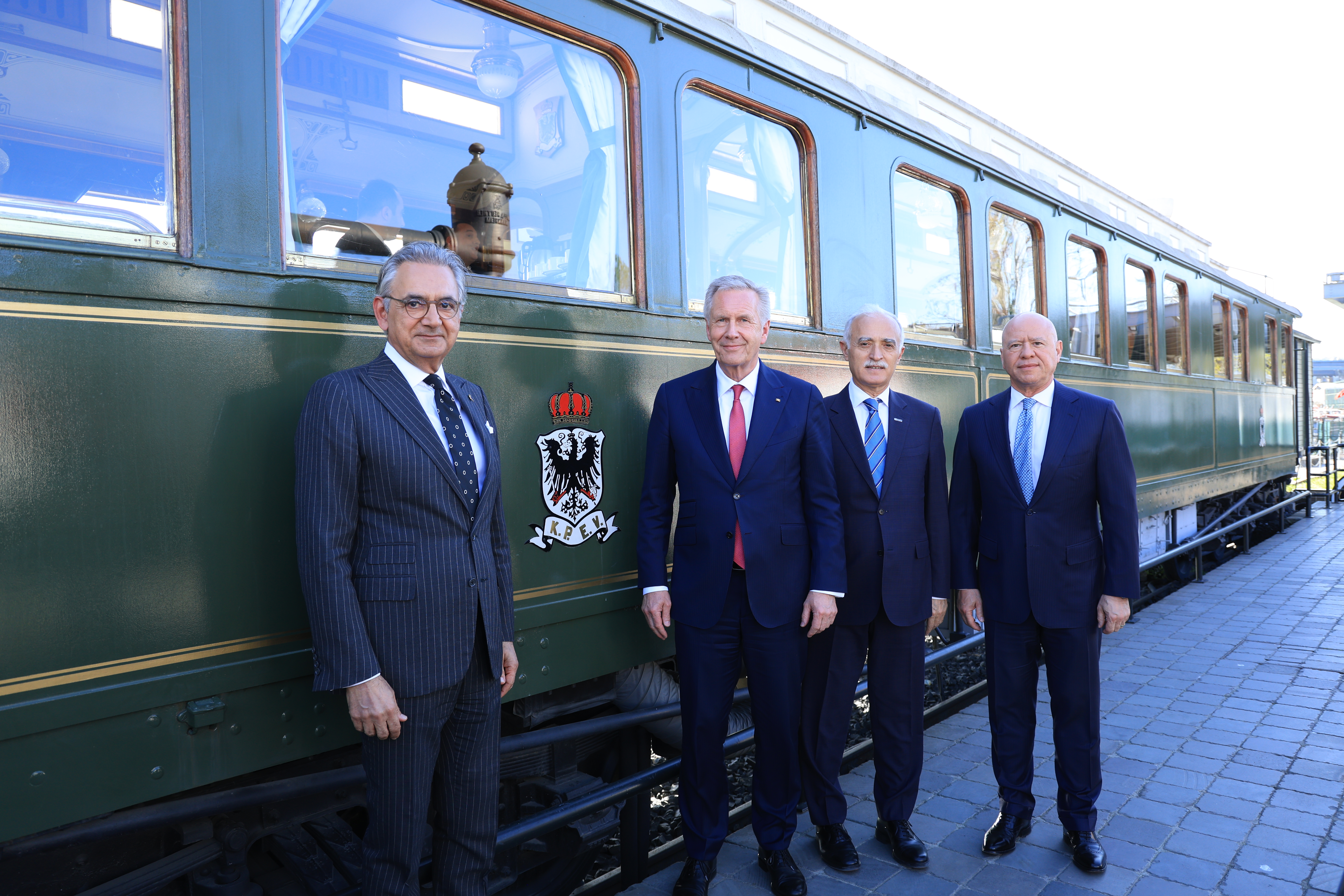
Following the meeting, DEİK President Nail Olpak, Honorary Chairperson of German-Turkish Business Council, Christian Wulff, and Chairperson of DEİK/Türkiye-Germany Business Vouncil, Mehmet Ali Yalçındağ visited the historic wagon at Rahmi Koç Museum, gifted by German Emperor Wilhelm II to Sultan Mehmed V Reşad.
Related Pictures